// CATEGORY
All Smart Security
AI-driven security and attendance infrastructure that sees, verifies, and responds in real time.
Explore
AI-powered incident detection and alerting — fusing video, sensors, and panic triggers into verified alerts with coordinated response workflows.
Security response time is decided in seconds. ZebIQ builds incident detection and alerting systems that compress the gap between something happening and the right people knowing about it. AI video analytics, IoT sensors, panic triggers, and staff reports feed a single detection engine that verifies events, classifies severity, and dispatches alerts to exactly the people who need to act — with location, live footage, and response protocol attached.
Your facility faces a diverse range of threats. Our detection coverage spans:
Multi-source verification keeps false alarms from eroding trust — a video detection corroborated by a sensor or second camera escalates with far higher confidence than a single noisy signal.
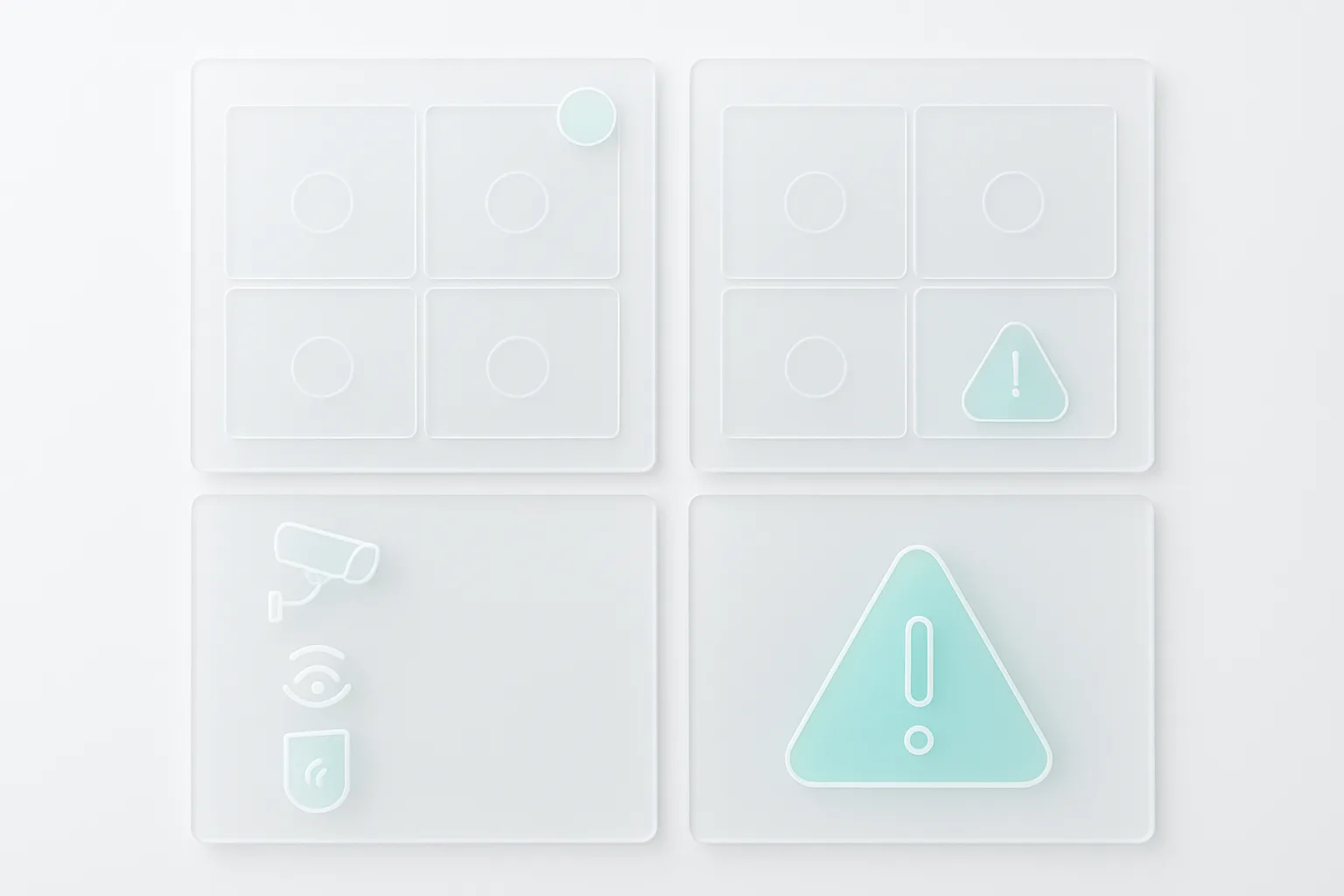
Multi-signal corroboration and severity scoring keep false alarms low and trust in the system high.
Per-incident-type notification chains across dashboard, mobile, and radio, with acknowledgement tracking and auto-escalation.
Panic buttons for staff and discreet SOS points for attendees, each raising located, prioritised alerts instantly.
Every event logged from detection to resolution — the record post-incident reviews, insurers, and authorities require.
We catalogue the incident types that matter for your site, and define severity levels and response protocols with your security lead.
Detection coverage — video analytics, sensors, and trigger points — is deployed against the threat map and tuned per zone.
Notification chains and escalation rules are configured, then validated through live drills with your response teams.
The system runs through your event or as a permanent capability, with incident reports and tuning reviews on a defined cadence.

Single-source detections are noisy. A camera picking up movement, a sensor threshold crossed, or a staff report in isolation — each can be a false alarm.
Our multi-source verification layer changes that. When video and a sensor both detect the same incident, or when two independent cameras see the same event, confidence rises dramatically. Severity scoring then routes true alerts to the right teams and appropriate channels — medical incidents to medics and control room, intrusions to security with live footage.
The result: your control room and response teams act on verified, prioritised information, not noise.
The speed and accuracy of incident detection directly determines whether response teams can prevent escalation or simply manage its aftermath.
Three ways: per-zone tuning of detection sensitivity during commissioning, multi-source verification so single noisy signals do not escalate alone, and severity classification so minor events inform rather than interrupt. False-alarm rates are reviewed and tuned as an explicit metric after go-live.
Whoever your response protocol says — per incident type and severity. A medical alert may go to the nearest medic team and control room simultaneously; an intrusion to security with a live camera view. Channels include the control dashboard, mobile push, and radio integration, with automatic escalation if an alert is not acknowledged in time.
Largely, yes. The detection engine processes standard IP camera feeds and integrates common sensor and alarm systems through open protocols. The deployment assessment maps what your current infrastructure can support and where targeted additions are needed.
Intrusion, fights and aggressive behaviour, falls and medical incidents, fire and smoke, unattended objects, crowd surges, unauthorised vehicle movement, and manual triggers from panic buttons or SOS points. Detection coverage is configured to match your facility's actual threat profile.
Let's map your facility's incident landscape and build a detection and response system that turns alerts into action.
// CONTINUE EXPLORING
Up to the category, across to complementary services, and into the engine-room notes.